Why I Paint With Both Hands and Algorithms
Imagine The Shining not as a film directed by Stanley Kubrick, but as an algorithm iterating endlessly over scenes, lighting, and frame compositions. What would horror feel like if it were entirely generated without the human eye, without instinct, without the microgestures Kubrick demanded from his actors? Would the hotel corridors still loom with dread, or would tension dissolve into statistical predictability?
This is the question I explore every time I paint with both hands, one holding a brush, the other steering lines of code. My studio has become a hybrid laboratory where paint, pigment, canvas, and digital networks coexist, each proposing possibilities the other could never imagine alone. One hand scratches, presses, hesitates; the other types commands, tweaks neural parameters, nudges a generative system toward some elusive aesthetic goal. Together, they negotiate a visual conversation that is intimate, experimental, and astonishingly precise.
Painting in this dual mode challenges conventional notions of authorship. A brushstroke signifies intention, hesitation, or improvisation, a trace of human presence. Algorithms, in contrast, offer multiplicity, speed, and pattern recognition at scales impossible for the human mind. They can iterate thousands of textures in seconds, reveal subtle symmetries, and suggest color harmonies that defy expectation. Yet without human curation, these systems remain purposeless. The brush alone cannot access the unbounded permutations an algorithm produces, and the algorithm alone cannot discern what resonates. Hybrid painting becomes a negotiation, a continuous dialogue between instinct and computation.
In practice, these moments are surprising and revelatory. I recall a painting where thick, gestural acrylic marks had already defined the composition. A generative suggestion layered faint, fractal, like patterns over the canvas, unexpected branching shapes that echoed tree limbs in a dreamlike cadence. That digital whisper transformed the work, guiding my hand to embrace rhythm and subtle tension I hadn’t anticipated. The result was a harmony of precision and spontaneity, a moment when computation inspired intuition rather than replaced it.
This dialogue between hand and machine resonates with the work of artists like Sougwen Chung, whose recent exhibition at Pace Gallery explored collaborative mark-making with robotic extensions. Seeing her approach reinforced that human-AI collaboration is not a novelty but a profound expansion of artistic perception. Algorithms extend imagination while consistently reminding us that the subtleties of intention, the hesitation before a stroke, the modulation of pressure, the imperfect layering of color remain irreproducibly human.
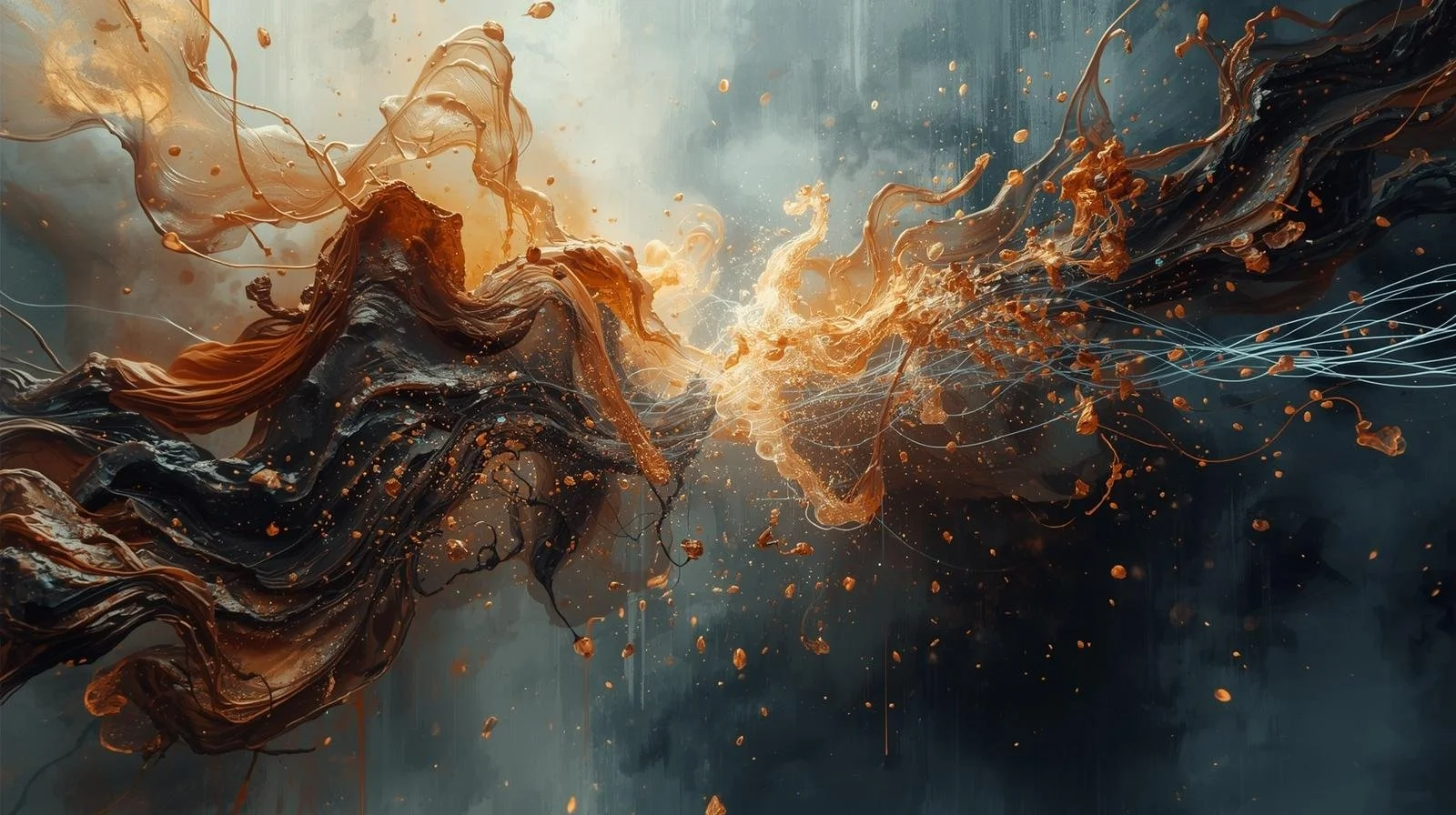
Visually, hybrid canvases oscillate between precision and spontaneity. Luminous neon arcs emerge beneath gestural ochres, fractal-inspired textures weave through delicate washes of watercolor. The algorithm occasionally generates patterns that shimmer like heat rising on a summer street, almost imperceptibly alive. Sometimes its output is starkly geometric; the brush introduces fluidity, tension, or imbalance. The contrast is deliberate: a space where instinct meets computation, intuition meets calculation, and emotion meets logic.
Working in this mode has reshaped my perception of time and choice. Algorithms operate at impossible speeds, iterating thousands of compositions in seconds. In contrast, I slow down, weighing subtle differences in texture, hue, and form. Each iteration is an invitation to refine taste and deepen intuition. One unexpected insight has been how algorithmic suggestions reveal patterns in my own perception I had never consciously noticed, sharpening both awareness and emotional responsiveness.
The hybrid workflow also resonates beyond painting. In UI design, soft gradients and subtle motion can evoke emotional clarity; in fashion visualization, fluid, responsive textures translate algorithmic suggestions into tactile surfaces; in immersive installations, algorithmically-driven atmospheres guide viewers’ perception and presence. Across disciplines, digital suggestion becomes a partner for subtlety, rhythm, and experiential resonance.
Ultimately, hybrid painting is an exploration of collaboration, risk, and curiosity. The machine is not a competitor or replacement; it is a provocateur, a partner, and a mirror. Together, brush and algorithm negotiate, improvise, and discover, producing work that is simultaneously human, algorithmic, and entirely alive. These experiments also inform the AI-generated visuals I created for this blog, where hand and machine collaborate to translate feeling into form. In that negotiation, creativity expands, intuition sharpens, and the work emerges: alive, precise, and unmistakably human.