Fire, Concrete, and Emotion: Painting Athena
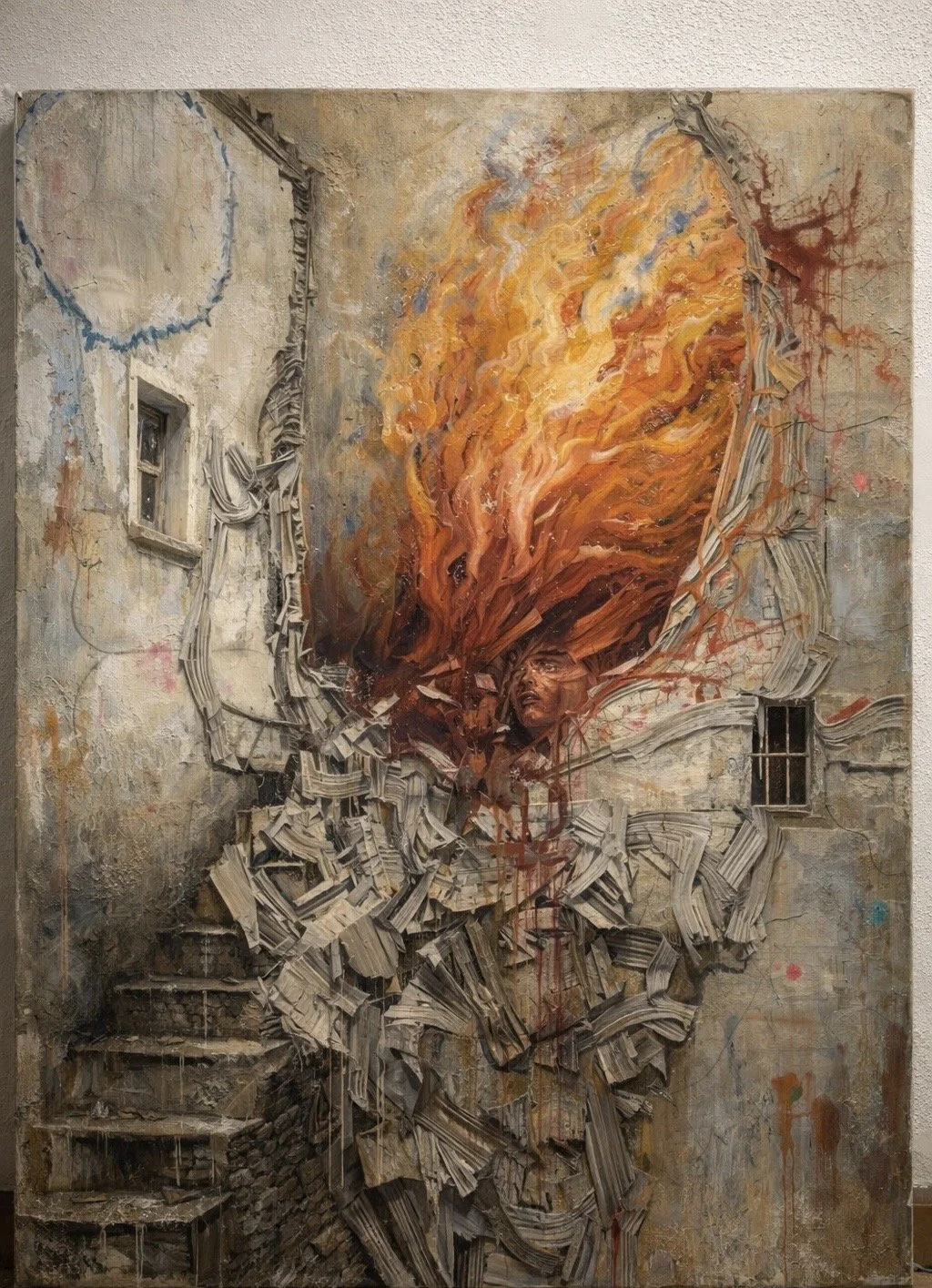
I watched Athena on the night my heart broke. The timing felt almost scripted: a film driven by rage, grief, and urban rupture arriving just as my own emotional structure collapsed. On screen, smoke thickened corridors, fire licked concrete walls, bodies moved with urgency and despair. Off screen, I recognized the feeling immediately. The film didn’t distract me from heartbreak, it gave it form.
Gavras’ Athena is not merely watched; it is endured. Its relentless forward motion, anchored by long, unbroken takes, transforms space into pressure and time into urgency. Concrete estates become emotional infrastructure. Barricades read like boundaries breached too late. What unfolds is not chaos for spectacle’s sake, but a carefully constructed anatomy of grief, anger, and systemic fracture. In that sense, the film feels less like narrative cinema and more like an extended visual composition: rigorous, immersive, and deeply physical.
The estate at the center of Athena operates as a metaphorical body. Its corridors, stairwells, and barricades mirror the architecture of loss: trust eroded, memory destabilised, violence erupting where language fails. Gavras films these spaces with near-architectural precision, allowing light, shadow, and movement to carry emotional weight. In response, colors of my painting dissolved into gesture. Structure gave way to abstraction. Light became confession. Shadow became companion.
Yet for all its volatility, Athena is strikingly controlled. The film’s visual intelligence lies in its discipline. Fire becomes sculptural. Smoke becomes texture. Silence, perhaps most powerfully, becomes moral space. These qualities translated directly onto canvas: expanses of muted greys interrupted by sharp, almost violent incursions of color. The tension between stillness and eruption between anticipation and impact became the work’s central rhythm.
As a piece of cinema, Athena is unapologetically confrontational. It refuses comfort, offering instead immersion and reckoning. Gavras does not aestheticise violence; he frames it as consequence. Every composition feels intentional, every movement charged. It is overwhelming at times, but its intensity feels earned, grounded in social reality rather than spectacle. This integrity is what makes the film resonate beyond its immediate narrative. It lingers, unsettles, demands response.
Painting the film clarified something essential for me: emotional intensity is not excess; it is material. Grief has texture. Rage has rhythm. Chaos has structure. Painting allows these states to slow down, to be examined, layered, held. In translating Athena to canvas, I wasn’t preserving the film, I was responding to it, allowing its emotional logic to collide with my own.
Ultimately, Athena operates as both cinematic event and emotional catalyst. On canvas, it becomes a visual manifesto: personal and political, volatile yet composed. The process revealed a quiet truth: heartbreak does not diminish perception; it sharpens it. Loss expands the emotional register. And cinema, when handled with this level of intelligence and restraint, becomes more than storytelling. It becomes a bridge between inner experience and collective reality.
In the end, both the film and the painting function as acts of witnessing. Witnessing rage, grief, rebellion, and fleeting beauty within destruction. They are not designed for comfort, but for presence. Athena burns, and in translating it, my own emotions became pigment, gesture, and rhythm. What remains is a visual language shaped by fire and feeling: proof that art, at its most honest, does not soothe. It reveals.