Chromatic Overload: Painting the Emotional Pulse of Noé
Gaspar Noé’s cinema is a full-throttle assault on perception: light, color, and movement converge to disorient, mesmerise, and seduce. Watching his films, the viewer is pulled into a sensory vortex, a space where emotion is not represented but felt as a physical force. For a painter, this is an irresistible invitation: how do you translate the raw, pulsating intensity of cinematic climax onto a static surface, without losing the rhythm, the charge, the illusion of motion?
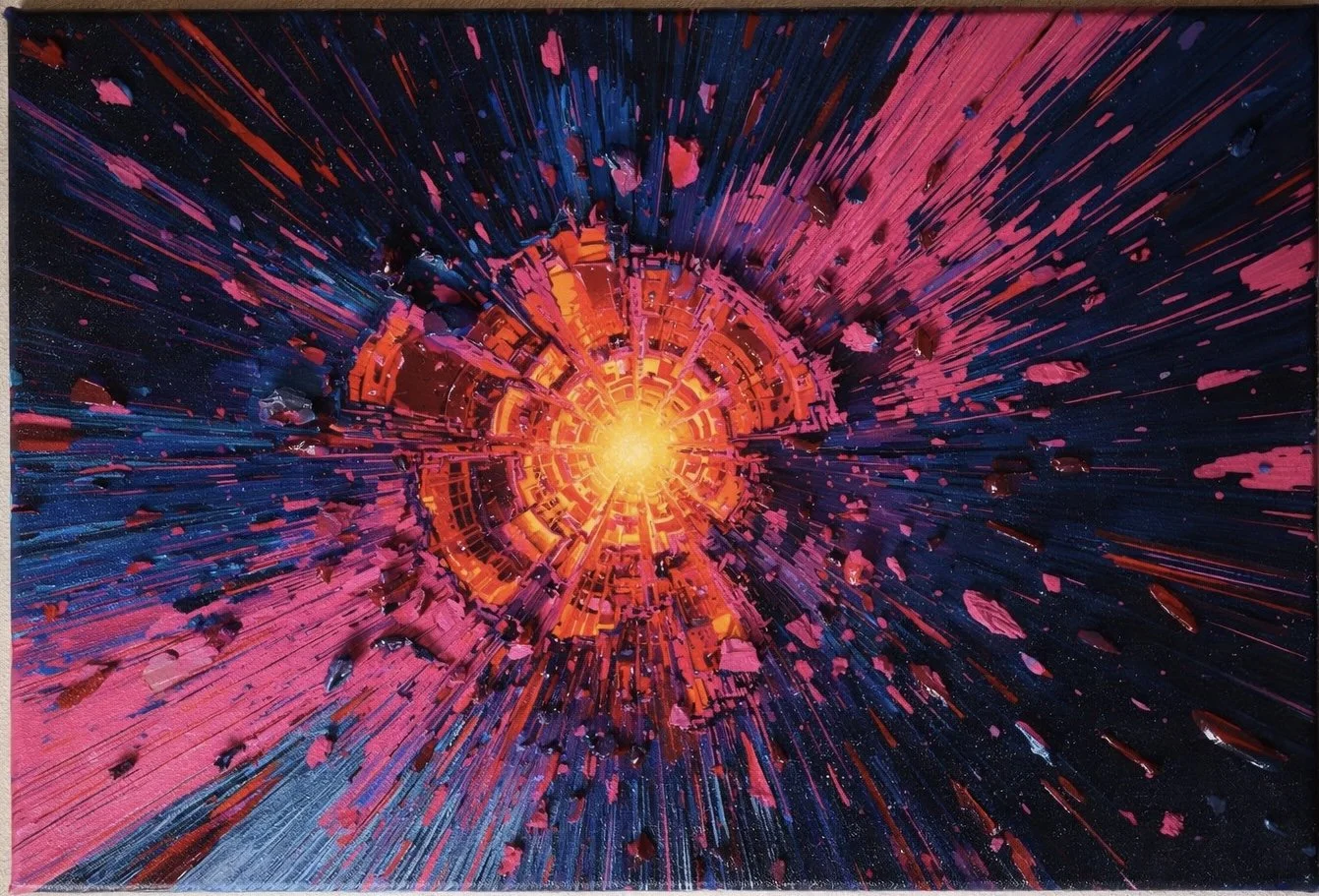
In my canvases, I pursue what Noé achieves through light and lens: emotional saturation and sensory disruption. Layers of saturated pigment collide like strobe-lit frames; neon pinks, electric blues, and molten reds surge across the surface, overlapping, vibrating, and at times threatening to spill beyond the boundaries of the canvas. Each brushstroke becomes a heartbeat, a pulse, a vertigo-inducing flash, capturing the intensity of feelings before they settle into consciousness.
Noé’s work teaches the power of temporal compression and expansion. In painting, I mimic this with rhythm: areas of dense, visceral texture interrupt stretches of translucent washes; jagged, impulsive gestures contrast with fluid, meditative arcs. The viewer experiences a moment of tension followed by release, a visual analog to cinematic pacing. Juxtaposition becomes narrative: chaotic swathes of pigment suggest panic or desire, while subtle, almost imperceptible gradients whisper memory, longing, or reflection.
Texture is emotional architecture. Thick, impastoed ridges act as physical echoes of sound and movement, mirroring Noé’s assaultive soundscapes and kinetic camera work. Smooth, luminous passages evoke fleeting clarity, the delicate moments of introspection between extremes. Light interacts with these surfaces, shifting perception, creating optical illusions that mirror the instability of feeling, blurring the line between the canvas as object and the canvas as immersive experience.
Philosophically, translating Noé to paint is an exploration of embodiment and sensation. His climaxes are not merely visual, they are felt in the body, in the gut, in the nervous system. Painting in this register asks: how can pigment encode tactile, visceral, and pre-verbal emotional experience? How can color and texture create the sensation of vertigo, lust, fear, or ecstasy? Each canvas becomes an experiment in making emotion material, illusion tangible, and perception malleable.
Ultimately, to paint the emotional pulse of Gaspar Noé is to embrace excess, intensity, and unpredictability, while still retaining the subtlety of human feeling. The work is not safe; it does not soothe. It seduces, overwhelms, and invites the viewer to linger in the liminal space between perception and emotion, between sensation and reflection. Like Noé’s films, it is an immersive encounter, a chromatic symphony of experience, where color, texture, and rhythm pulse with life beyond the frame.